Tours
Mis tours-

Tarjeta Turística de Roma
Tarjeta Turística de Roma
Este boleto combinado le da acceso a los 5 mejores lugares de la ciudad de Roma: el Coliseo (incluido el Foro Romano y la Colina Palatina), los Museos Vaticanos y la Capilla Sixtina, San Pedro (visita guiada) y Bus turístico por Roma.
Leer más... -
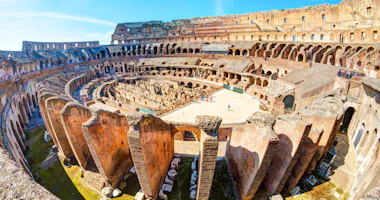
Coliseo, Foro Romano y Colina Palatina: Entrada Prioritaria
Coliseo, Foro Romano y Colina Palatina: Entrada Prioritaria
Sáltate las largas colas con este boleto de entrada. Después de visitar el Coliseo, puedes ir al Foro Romano y Monte Palatino que se encuentran opuesto al Coliseo.
Leer más... -

Museos Vaticanos y Capilla Sixtina
Museos Vaticanos y Capilla Sixtina
Saltarse la línea y visite las espléndidas habitaciones y las innumerables obras maestras de Miguel Ángel, Rafael en la Capilla Sixtina y admira enormes frescos del Juicio Final.
Leer más... -

Galleria Borghese: Entrada reservada
Galleria Borghese: Entrada reservada
La Galería Borghese en Roma alberga obras de Caravaggio y Bernini, antes colección privada del cardenal Scipione Borghese. Admira el claroscuro de "San Jerónimo escribiendo" y el David de Bernini, capturado en pleno movimiento. Sin colas.
Leer más... -

Basílica de San Pedro: Visita guiada exprés
Basílica de San Pedro: Visita guiada exprés
Descubre la Basílica de San Pedro con una visita guiada exprés y entrada reservada, sin colas. Tu guía te mostrará la cúpula de Miguel Ángel, el Baldaquino de Bernini y la Piedad, obra maestra de Miguel Ángel.
Leer más...
Basílica de San Clemente
Just a few meters away from the Colosseum, you have the chance to take a fascinating journey through history. The church of San Clement, with its complex underground layers, is a real “time machine” which will give you the opportunity to discover many secrets of the last 2000 years of history.
For 300 years now, the church has been a convent of Irish Dominican friars, who have greatly contributed to bring back to light some unique remains of an antique past. Over the many examples of “layered” worship sites, this is probably the most famous one. Also, these subterranean halls preserve the very first evidence of the early Italian language, in an inscription which shows something very different from the courtly lexical elegance of Latin. We’ll begin our journey from the bottom, more than 10 meters below the ground, at a time when the site was not even consecrated to Christ.·

The Lower Temple and Roman Domus
Two levels under the ground, we find the well preserved remains of a pagan temple and also a Roman house, a “domus”. Actually the latest archaeological findings have confirmed that the base of the site probably belongs to the upper ceiling of a Roman building that was destroyed during the great fire of 64 AD. This area was part of the large Nero’s estate, which included the famous Domus Aurea, his private and luxurious residence. After Nero’s death, his great palace was demolished and the whole area was reorganized. A few meters away, the new emperor decided to create one of the largest arenas of the ancient world (the Colosseum) whilst the Empire's mint was probably located here. Just beside it, there was a private patrician home, a domus. And the remains are clearly visible: you can see some of the rooms, with frescoed walls and stucco decorations on the ceilings.
From the third century, a new cult arrived in Rome, and it slowly gained followers. The house was converted into a temple for the new religion, the Mithraic cult. Mithra was a deity belonging to the Persian tradition of the so-called mystery cults. The worshippers were men only and there were seven levels of initiation. The temple, called “mithreum”, is a cave-like room. Mithra was believed to be born from a rock and, by the will of Apollo, he was committed to redeeming humankind. In this mithreum you can see an ancient altar with a sculpture of Mithra killing a bull. A hundred years later, Christianity was the official religion of the Empire. The temple was abandoned and the whole area became the foundation of a new church.·
The First Church dedicated to San Clement
We now have to rise up one level, to enter the amazing remains of the first basilica, a church built in the V century AD in honor of Clement, who was the third pope in line after Peter, in the II century. At those times, Christians were still actively persecuted. Clement was sentenced to hard labor, exiled in Crimea, but that didn’t stop him continuing to convert his fellow prisoners. For this reason, he was sentenced to death: he was tied to an anchor and thrown into the Black Sea.·
The structure of this underground church features porticoes and colonnades. Some of the upper parts have been incorporated in the church above. This basilica has been used for more than seven centuries, and bears the legacy of artistic and architectural development during the different times. For example, you can admire a mosaic floor created with many tiny pieces of colored marble. Each type of marble comes from a different part of the countries overlooking the Mediterranean sea, to testify the spread of the Christian religion across the known world.
On a wall, there is a unique fresco of the Holy Mary dated VIII century. One of the chapels is dedicated to the inventor of the Cyrillic alphabet, St. Cyril. His tomb, dated IX century, is still well preserved, together with a painting depicting the saint.·
The excavation works are still in process and continue to reveal new and interesting memories of the past. To preserve this site there are sensors that record the levels of humidity and the variations in temperature.·
In recent years, a 4 meter diameter marble baptismal font has been discovered. Also, there are the remains of a sacristy that was used by the popes while they visited all the Roman basilicas during the Lenten season. When Rome experienced the troubled barbaric invasions, especially the ones of the Norsemen, there was instability on a social and political level. Some of the areas of this church were converted into a cemetery, and we can even see some tombs carved into the walls. The tall skeleton found in one of these burial places probably belonged to a Norseman.
Those warring armies arrived in Rome in 1084 following the request of Pope Gregory VII who wanted to be freed from the siege of the German troops under the command of the Emperor Henry IV. But, once the Norsemen defeated the Imperial army, they extensively sacked the city. Still, they where, after all, already converted to Christianity, so they used this site as burial grounds.


The Upper Basilica: A Romanic Jewel
You are now at ground level and you are probably wondering why the second (and last) church was built “on top” of the older one. Why didn’t they simply renovate the first one? The reason can be found in the peculiar morphology of the area. This is a valley between two hills, and, as centuries passed, it was slowly filled with sediments. Centuries ago, the ground level was in the Roman domus where you first started your visit, two levels below.
In the year 1100, Pope Pascal II decided to rebuild the church, which had suffered from the looting of the Barbarians and was probably largely damaged. The upper basilica is a masterpiece of Christian art. Some of the most valuable “pieces” of the lower church were moved here. Pascal, a Benedictine monk, was nominated pope in this very place, in a time when there were bitter struggles between the papacy and the empire, and the most influential families of the Roman aristocracy kept backing one faction or the other, depending on their political interests. Pascal wanted to give a clear sign that the Papal power (both spiritual and secular) was stronger than the German Empire, and that’s why he decided to renovate many churches in Rome. His inspiration was the Benedictine monasteries, places of prayer and recollection.
San Clement, with its rigorous Romanesque architecture, later enriched with a Baroque touch, is a powerful example of the ideals brought forward by the highest representatives of Christianity during the Middle Ages.·
Just outside the church, there is a four-sided portico. The facade and the bell tower were designed in the XVIII century by Carlo Stefano Fontana, the nephew of Carlo Fontana (St. Peter’s Baptismal font, the Montecitorio Palace – house of the parliament).·
The basilica has three naves with ancient columns. The floor is in Cosmatesque style. The Cosmati masters were a Roman family of marble workers who had various workshops around town. For four generations, between the XII and the XIII centuries, they worked in many churches, creating mosaics, statues and decorations. Their “signature” works included elaborated mosaics created with marble and glass.·
Qué Ver en la Iglesia
En su interior, la iglesia presenta una estructura de tres naves. Su arquitectura románica se ha visto alterada con decoraciones barrocas posteriores, y en general la iglesia conserva las “huellas” artísticas de sus muchos siglos de existencia. Entre las numerosas obras maestras, esto es lo que no puedes dejar de ver.
EL MOSAICO DEL ÁBSIDE: Este espectacular ejemplo de mosaico medieval se conserva en un estado sorprendentemente bueno. Su diseño es una metáfora de la fuerza vivificadora del Nuevo Testamento. En el centro aparece Jesús crucificado, entre la Virgen María y san Juan Evangelista. Toda la escena está dominada por espirales de vides que brotan: el mensaje del Evangelio tiene el poder de devolver la vida a la Iglesia, y es el sacrificio de Cristo lo que lo ha hecho posible. Las palomas que rodean a Cristo simbolizan a los doce apóstoles. El estilo de este brillante mosaico tiene puntos en común con el gusto artístico de los mosaicos romanos más antiguos, especialmente en la forma imaginativa de representar pequeños detalles, como las flores que adornan las vides.
LA SCHOLA CANTORUM: Desde los inicios de la liturgia romana, los himnos sagrados formaron parte de las celebraciones. El salmista y los cantores se ubicaban en un recinto erigido al final de la nave central de la iglesia. En concreto, el salmista entonaba el primer versículo de los salmos, y los feligreses respondían con la otra parte. La Schola Cantorum que ves aquí se construyó utilizando numerosos fragmentos de la mucho más antigua que se encontraba en la basílica inferior.
Al comienzo de la primera nave izquierda hay una capilla dedicada a santa Catalina de Alejandría, decorada con frescos de los artistas Masolino da Panicale y Masaccio.
Latin vs Italian: the Saint against the Prefect
Hidden in the fresh and artificially lit halls of the first basilica, there is a fresco that not only tells a story, but it is also the first “document” which involves the use of an early version of the Italian language. In the V century, when the first church was built, Latin was the official language of the Empire and then of the· Papal State. Italian was only spoken by commoners and wasn’t present in any official inscription or spoken during official ceremonies or events.·
The fresco, called Giudizio Particolare (Particular Judgement) tells the legend about an episode of the life of St. Clement. The wife of Sisinno, the prefect of Rome, was secretly a Christian. One day, her husband, with some of his slaves, followed her, and found the lady attending a mass celebrated by Clement. He was furious, and ordered his slaves to capture Clement. As per divine intervention, he and his slaves were temporarily blinded. They mistook the pope for one of the columns in the hall, finding it of course very hard to move it and take it with them. In the inscription, Sisinno urges his servants to capture the “pope”, using a very colorful expression indeed, which is written in Italian. In the same fresco there are some words in Latin, attributed to Clement.
The use of the two languages was to show the different cultural level of Clement, who spoke Latin, and Sisinno, who could only express himself in a lower-level language and, on top of that, using swear words! Italian became fully developed with its grammar, syntax and lexical complexity, only around the XIII century. In the beginning, the Italian language was called “Volgare”, which means “belonging to the common people”. It has to be noted that, in Italian, the adjective “volgare” (vulgar) has, a definite negative connotation in today’s language.
Travel Tips and How to Get To San Clement
The church is open from Monday to Saturday in the following hours: 09.00-12.30 and 15.00 -18.00. On Sundays and on public holidays, it’s open from 12.00 to 18.00. As in every church in Rome, you should not enter with bare shoulders or shorts. Also, it is advisable to switch off your phone while you are inside. The whole site, including the lower levels, is equipped with a video surveillance system, for the safety of the pilgrims and the visitors. It’s forbidden to take pictures or videos in the archaeological area.
Due to Covid-19 restrictions and protocols, it is necessary to book your visit to the church in advance, to secure your place in the hours and dates of your interest. You can check prices and availability on this page here.
You can arrive here with the subway, Metro Line B (metro stop Colosseo) and walk for about 10 minutes on the road called Via San Giovanni in Laterano. From St. Peter’s, you can catch the bus 571 and disembark at the second stop after the Colosseum. Otherwise, if you are coming from Venice Square, you can catch bus 85 or 850 for 5 stops and you’ll arrive approximately 50 meters from the church’s entrance. The address of San Clemente is Via Labicana 95.

Artículos relevantes

Basílica de San Pedro
Además de ser la Iglesia más importante de El Vaticano, cabe destacar que la Basílica de San Pedro llegó a pasar por manos de artistas italianos reconocidísimos
Leer más...
Basílica de San Juan de Letrán
De las cuatro basílicas papales de Roma, la Archibasílica de San Juan de Letrán es la más antigua. También se considera como la basílica principal y una de las siete iglesias de peregrinación.
Leer más...
Basílica de Santa María la Mayor
La Basílica de Santa María La Mayor es una de las cuatro basílicas de Roma. Es una de las iglesias más impresionantes de Roma y aunque pertenece a la Santa Sede, se encuentra fuera de la Ciudad de El Vaticano.
Leer más...
El Coliseo
El Coliseo o es el monumento más grande y famoso del Imperio Romano. Originalmente un lugar de entretenimiento, especialmente conocido por sus batallas de gladiadores, es el monumento más famoso de Roma y una de las siete maravillas del mundo.
Leer más...